
Five Tabs Every Morning and Leads Going Cold Anyway
Real estate lead follow-up automation is one of the highest-ROI fixes I’ve seen in a brokerage setting. Most teams don’t need new tools. They need the ones they have talking to each other.
There is a broker I worked with in Bozeman who has been in luxury real estate for more than twenty-five years. She knows the market. She knows her clients. She is genuinely good at her job in a way that takes decades to build.
What she was not good at, and knew it, was the first thirty minutes of every workday.
Every morning: open the CRM, check for new leads. Open Gmail, scan for inquiries. Open Google Calendar, review the day. Open the tracking spreadsheet, update follow-up notes. Check MLS alerts, look for new listings matching client criteria. All five of these. Every day. Before she could actually start working.
Real estate lead follow-up automation was not something she had thought about by name. She had thought about it the way most business owners think about it: as something she should probably deal with at some point, once things slowed down.
The Real Cost of Five Separate Platforms
The five-platform morning routine sounds manageable until you add up what it actually takes. Fifteen minutes, give or take, every single day just to figure out what happened overnight and who needs attention. Over a week, that is over an hour. Over a year, it is days.
That is the visible cost. The less visible one is what happens to leads that arrive at the wrong time.
She manages a three-person team. When a new inquiry comes in at 6pm on a Tuesday, it sits in the CRM inbox until someone sees it. If the team is busy, it might not get a response until the next morning. In luxury real estate in a competitive market, that window matters. A buyer who reached out to three agents and heard back from one by 6:15pm has often made a decision about who they want to work with before anyone else checks their inbox.
The follow-up that does not happen is almost always invisible. There is no record that says “this person went with another agent because we were slow.” The lead just goes quiet and eventually gets marked as unresponsive.
What Fragmented Systems Actually Look Like From the Inside
When we mapped out how the team was actually operating, a few things stood out.
First, there was no standard for what “followed up” meant. One team member might send a personal email. Another might log a call. Another might send a template. The CRM had records, but the records were inconsistent because the process was inconsistent.
Second, there was no escalation. If a lead came in and nobody responded within twenty-four hours, nothing flagged it. It was possible for an inquiry to sit for days with nobody realizing it had not been touched.
Third, the daily review was done from memory as much as from the system. The team knew who their hot leads were. They were less clear on the ones that had gone quiet two weeks ago and might be ready to re-engage.
None of this was negligence. It was what happens when a growing business outpaces the systems it started with.
What Real Estate Lead Follow-Up Automation Actually Looks Like
The build had two parts.
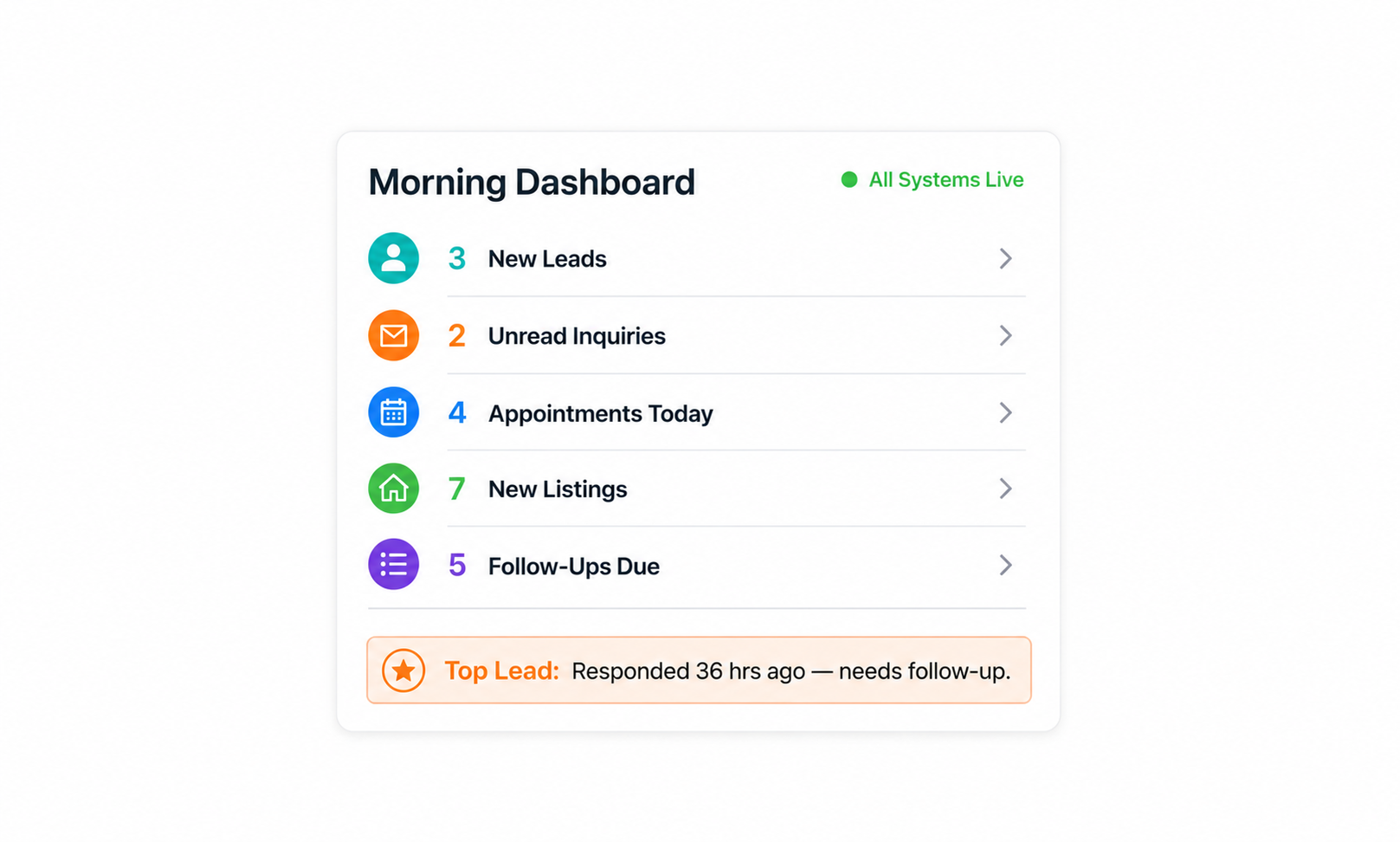
The first was a daily command center: a single dashboard that pulled all five platforms into one view each morning. New leads from the CRM. New emails. The day’s appointments. The follow-up tracker. New MLS listings matching each active client’s criteria. All of it in one place, ranked by priority.
The ranking piece was the part that made the most difference. Instead of opening five tabs and deciding for herself what needed attention, the system surfaced the top ten leads to focus on, ordered by follow-up recency, lead source, and engagement signals. The decision about where to start was made before she opened her laptop.
Notes added in the dashboard synced back to the CRM automatically. One action, one record update.
The second part was the lead response system. When a new inquiry arrived, the team got an instant SMS. Within minutes, an AI-drafted response went out using Claude, written to match the professional tone the brokerage maintains. The lead got logged in the CRM automatically. If no response was recorded within a defined window, an escalation alert fired.
The escalation piece closed the gap that was costing the most. A lead that arrived at 6pm on a Tuesday now had a response within minutes and a human following up the next morning with context about what had already been said.
The Part That Is Easy to Underestimate
I want to be direct about what AI-drafted responses can and cannot do in luxury real estate.
A first response to an inquiry does not need to be deeply personal. It needs to confirm that a real person received the message and will be in touch. “Hi, I got your note about the property on Main Street. I’ll call you tomorrow morning to answer your questions” is more valuable than a perfectly crafted paragraph that arrives two days late.
That is where the automated draft earns its place. It handles the acknowledgment immediately so the human follow-up, when it happens, starts from an already-engaged lead rather than a cold one.
What AI cannot do is replace the relationship work that makes a twenty-five-year career in luxury real estate worth something. The conversations, the market knowledge, the judgment calls. That is not what this system touches. It handles the operational layer so that layer does not get in the way of the actual work.
What Changed in Practice
The daily routine went from five tabs to one. The morning review that used to take fifteen or twenty minutes now takes five. The leads that were slipping through because nobody had an escalation mechanism no longer slip.
What I am careful about: I cannot tell you exactly how much revenue this generated. There are too many variables in a real estate business for that math to be clean. What I can say is that the specific problem we were solving, leads going cold because of slow response and fragmented tracking, has a documented cost in real estate, and the system addresses it directly.
The more meaningful shift might be this: the team now spends the first part of their morning on the work that requires them, not on the work of figuring out what requires them.
What This Looks Like for Other Real Estate Teams
The pattern here is not unique to luxury real estate. It is the same fragmentation I see in most service businesses that have grown past the point where one person can hold the whole picture in their head.
Multiple inbound channels with no unified view. Follow-up that happens when someone remembers to do it. No escalation when it does not. These are structural problems, not people problems. The team is not dropping leads because they do not care. They are dropping them because the system gives them no way to know a lead has been sitting untouched for thirty-six hours.
If you run a real estate team, or any service business where leads come in through more than one channel and response speed matters, the gap is almost always in the routing and escalation layer. That is the thing to look at first.
The FREE 30-minute systems audit is how we start that conversation. We map what is actually happening in your lead pipeline and tell you specifically where things are falling through.
Thayer is the founder of Waypoint Systems AI, an operational consulting firm based in Bozeman, Montana. He has worked with 30-plus service businesses on their operational systems. Book a free systems audit here. Related: what happens to after-hours leads at most service businesses.