
The Quiet Cost of Running Your Business on Manual
The cost of manual processes in business is one of the least visible expenses a service company carries.
Most small businesses are quietly losing 8 to 15 hours a week to manual processes. The problem isn’t that owners don’t see it. It’s that nobody has ever sat down and counted.
I had a conversation a couple weeks ago that’s been stuck in my head.
I was doing a systems audit with a physical therapy clinic in Bozeman. Family-owned, been around for about twelve years, good reputation, genuinely good at what they do. Before we got into the workflow stuff, I asked the owner, Carrie, a question I ask everyone: walk me through the last two hours of your workday yesterday.
She paused. Then she kind of laughed. “You really want to know?”
Yeah. I did.
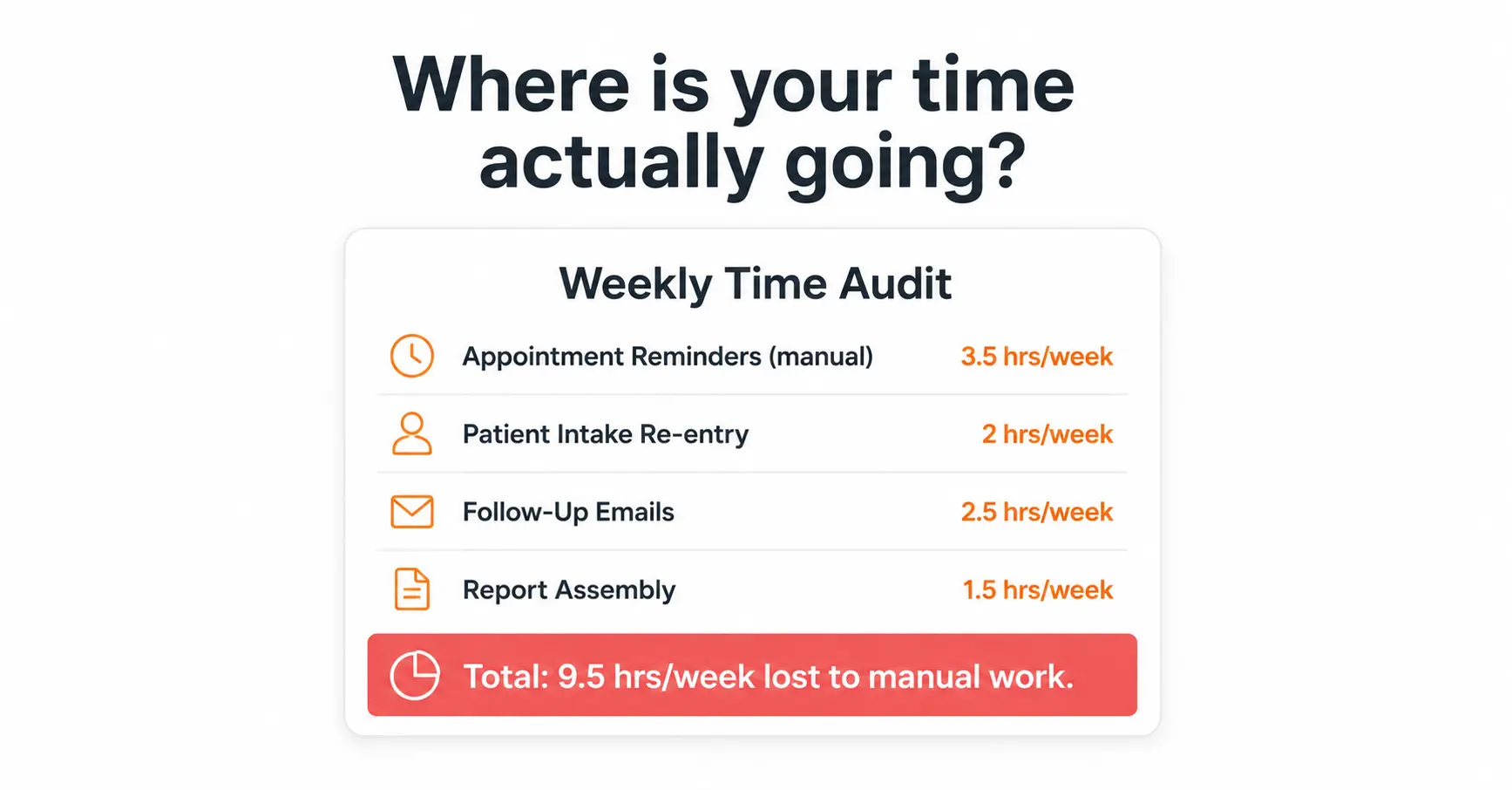
Here’s what she described: manually entering patient intake notes into a different system than the one the notes were originally taken in, because they hadn’t gotten around to integrating the two. Sending appointment reminders one by one because the automation in their scheduling software wasn’t configured. Chasing down an insurance form that should have gone out automatically two days earlier but hadn’t because of a process that relied on someone remembering to do it. Answering the same two patient questions by email that she had answered, by her own estimate, fifteen or twenty times that month.
When she finished she looked at me and said: “I know. It’s a mess. I just haven’t had time to deal with it.”
That sentence right there. That’s the thing I keep hearing. Not that people don’t see the problem. They see it every day. They feel it. It’s just become background noise. Expected. The cost of being busy.
What almost never happens is actually sitting down and counting the hours.
Why Manual Business Tasks Are Costing More Than You Think
So let me give you the exercise I do with every business I sit with.
Think about the last full week. What did you or someone on your team do more than twice or three times that was essentially the same task every time? List them out. Then estimate, honestly, how long all of those tasks took in total across the week.
Most people, when they actually do this, land somewhere between eight and fifteen hours. Sometimes more. That’s not the time it takes to run the business. That’s just the overhead on top of it.
Some of those hours belong to the owner, who has a lot of other things they could be doing. Some belong to people being paid a real salary to copy data from one platform to another, or to send the same follow-up email on a schedule, or to manually compile a report that could be generated automatically every Friday morning.
How to Calculate the Hidden Time Cost in Your Business
Now. I want to be careful here, because I think automation gets oversold constantly and I don’t want to do that.
Not everything should be automated. Client relationships need humans. Anything that requires real judgment needs a person with real judgment. Complex situations, sensitive conversations, anything where context matters, those need people.
But a lot of what I see in most businesses isn’t that. It’s appointment reminders. Follow-up emails after a job closes. Intake forms being re-entered by hand. Status updates that could be triggered by a workflow. Weekly reports being assembled manually every Friday instead of being generated and delivered automatically.
That work doesn’t need a human. It needs a trigger, a template, and a few hours of setup time.
Where Manual Work Tends to Cluster in Small Businesses
The places where manual work tends to cluster, based on sitting with probably sixty or seventy businesses at this point:
Intake is almost always partially manual somewhere. Getting a new lead or client into the system, capturing the right information, notifying the right people. Somewhere in that chain, usually more than one place, someone is doing something by hand that could be automated.
Follow-up is ad hoc in almost every business I’ve seen. The follow-ups that happen are the ones that someone remembered to do. Leads who don’t hear back aren’t being ignored on purpose. They just fell out of someone’s mental queue on a busy day. Invoices that go unpaid for weeks aren’t being ignored either. Nobody set up the reminder sequence.
Reporting requires someone to go collect information on purpose. That’s a weekly tax on someone’s time that produces a document that’s already slightly out of date by the time it’s shared, and has to be done again next week.
All three of these are fixable without buying new software.
What “Not Having Time to Fix It” Actually Costs You
The most common response I get when I start talking about fixing this: “I know I need to, I just don’t have bandwidth for it right now.” I hear this constantly and I understand it. When you’re busy, improving the operation feels like something for a slower week that never quite arrives.
But here’s what I’ve seen play out with enough businesses to say it with some confidence: the ones that never find time to fix their operations stay stuck in the same drag for years. Not because they don’t care. Because the window doesn’t open by itself. You have to make it.
And you genuinely don’t have to fix everything at once. Start with the thing that eats the most time and is the most clearly repetitive. Fix that one thing. Let it run. Then find the next one.
Carrie at the PT clinic: we started with two things. Automated appointment reminders, and an intake form that routed directly into her system without anyone having to touch it. Two changes. Took about a week to set up and test.
She called me maybe three weeks later. She said she’d gotten somewhere around four hours back per week just from those two changes. That was time she was spending on actual patient care and business development instead of data entry and reminder emails.
Four hours sounds modest. But that’s four hours every week, indefinitely. That’s meaningful.
The ROI Beyond Hours Saved
Here’s the thing about this kind of work that I don’t think gets said enough: the ROI isn’t just in the hours saved. It’s in what those hours get replaced with. When your team stops doing work that should be automatic, they do more of the work that actually requires them. The quality of client interactions goes up. The quality of follow-up goes up. The stuff that actually differentiates your business from the next one gets more attention.
That’s harder to measure but it’s real.
If you want to go through this for your own operation, the free 30-minute systems audit is exactly that. We walk through what’s actually happening in your business, find where the manual work is concentrating, and tell you specifically what it would take to fix it.
No pitch after that. No pressure to work with us. You’ll come out knowing something concrete about your operation that you probably don’t know right now.
Just book a time.
Thayer is the founder of Waypoint Systems AI, an operational consulting firm based in Bozeman, Montana. He has worked with 30-plus service businesses on their operations. Waypoint audits business workflows and builds the AI automation systems that fix them. Book a free systems audit here. If your follow-up is the problem specifically, read what happens to leads after hours at most service businesses.