
What Happened When 15 Real Estate Agents Actually Learned to Use AI
AI training for real estate agents mostly fails because it is too generic. Here is what a task-specific program looks like instead.
Almost every real estate agent in the country has heard of ChatGPT by now. Most of them have tried it at least once. A significant number typed something in, got back something generic or slightly wrong, shrugged, and went back to writing listing descriptions by hand.
That gap, between knowing an AI tool exists and knowing how to make it actually useful for your specific work, is where most real estate offices are sitting right now. They have access. They do not have a process.
A luxury real estate office here in Bozeman came to us with exactly this situation. Fifteen agents, a well-regarded office, clear brand standards. The tools were available. Nobody had taken the time to figure out how to use them in a way that fit the work.
AI training for real estate agents was the ask. What we actually built was something more specific than that.
Why Generic AI Training Does Not Work for a Real Estate Office
There is a version of AI training that goes: here is what large language models are, here is how prompting works, here are some general tips. It is accurate. It is mostly useless.
The reason is that the gap for working real estate agents is not conceptual. They are not confused about what AI is. They are confused about how to use it for the specific tasks they do every day: writing a listing description for a three-bedroom craftsman in a market where buyers have seen every superlative there is, drafting a follow-up email after a showing that feels personal rather than templated, summarizing a market report in a way that a client can read in two minutes.
These are specific tasks. Generic training addresses them generically, which means agents leave knowing more about AI and no more capable of using it for their actual work.
The training Waypoint designed was built backward from the tasks. We started by identifying the six workflows that consumed the most time and produced the most inconsistent output across the team: listing descriptions, client emails, market summaries, social content, offer drafting, and lead follow-up messages. The training was built around those six things, not around AI in the abstract.
Claude vs. ChatGPT: Why the Distinction Mattered
One of the foundational decisions in the training was teaching agents when to use which tool.
Most of the agents who had tried AI had tried ChatGPT. The experience with ChatGPT on longer-form, nuanced content, specifically the kind of brand-voice writing a luxury brokerage requires, was inconsistent. The outputs often needed significant editing to meet the standard the office maintained.
We introduced Claude as the primary tool for long-form content: listing descriptions, offer letters, detailed client communications. Claude handles extended context well and produces prose that requires less revision on nuanced tone. ChatGPT stayed in the picture for quick research, data lookups, and short-form tasks where speed mattered more than precision.
This distinction was not about brand loyalty to either platform. It was about giving agents a clear decision rule: for the writing that has to sound like the brokerage, use Claude. For quick lookups and short tasks, either works.
Having that rule mattered. Without it, agents were choosing randomly, getting inconsistent results, and drawing the wrong conclusion: that AI was not useful rather than that they were using the wrong tool for the task.
What the Actual Training Looked Like
The program ran in two modules.
The first covered foundations: how large language models work at a level that explains why prompting style affects output quality, the difference between the two tools, how to adapt AI outputs to match brand voice, and hands-on demonstration with real examples from the office.
The hands-on piece was important. The agents who had tried AI and stopped usually stopped because their first few attempts produced generic output and they did not know why. Seeing the direct connection between a specific prompt and a specific output, in real time, with their actual listings and their actual client situations, changed the mental model.
The second module was entirely practical: six workflows, live demonstrations of each, templates calibrated to the brokerage’s voice and the local luxury market, and guided practice where agents produced their first outputs under each workflow during the session.
Agents left the second module with six templates they could use the next day. Not concepts. Actual prompts, tested against their real work, producing outputs that met the office’s standards.
The 100% Adoption Number Requires Context
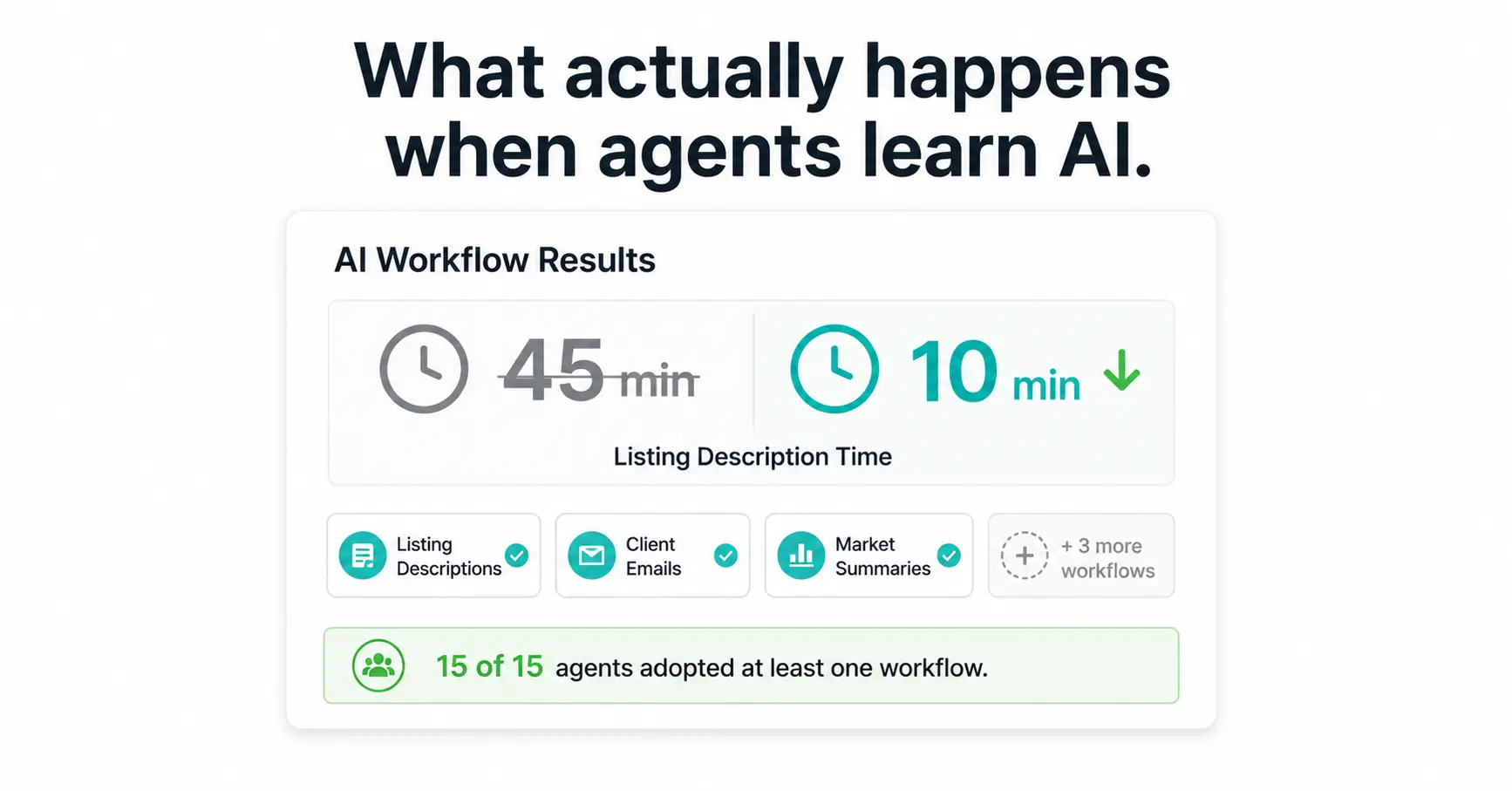
Every agent in the office, all fifteen, adopted at least one of the six workflows into their regular practice within the follow-up window. That is the number.
I want to be careful about what that means.
Adoption does not mean transformation. It means agents found the tool useful enough to use it for at least one recurring task. Some agents integrated it into daily practice across multiple workflows. Others adopted it for one specific task, usually listing descriptions, and left the rest.
The distribution of adoption was not uniform. The agents who invested the most in learning to prompt effectively got the most out of it. The agents who used the templates as-is without adapting them got less. That is predictable and not unique to AI: the more someone actually engages with a tool, the more value they extract from it.
What the training did was give every agent a starting point that was actually usable rather than generic. What they built on top of that starting point varied.
What Faster Content Production Actually Means for a Real Estate Agent
The outcome that mattered most day-to-day was time. The time to produce a listing description, a market summary, or a series of follow-up emails went down significantly for agents using the tools consistently.
A listing description that used to take forty-five minutes, including the rewriting and editing pass, could be done in ten. A market summary that required pulling data, writing it up, and editing for client clarity could be done in fifteen.
That time goes somewhere. For some agents, it went into more prospecting. For others, it went into being more responsive to clients. For a few, it went into better quality on the work that still required full attention: the conversations, the negotiations, the judgment calls that AI does not touch.
The consistency gain was harder to measure but real. Before training, listing description quality varied across the team, with some agents producing copy that reflected the brand and some producing copy that did not. After training, the floor came up. The templates gave everyone a starting point calibrated to the standard, which meant the variance in output quality narrowed.
What This Looks Like for Other Teams Sitting on Tools They Do Not Use
The situation here is everywhere right now. Teams that have access to AI tools, have been told to use them, and have not been given anything specific enough to make that possible.
The fix is not more access to tools. It is a defined process for using the tools you already have on the tasks that actually consume your time.
For a real estate office, those tasks are specific: listing content, client communication, market reporting, follow-up. Building training around those tasks, rather than around AI in the abstract, is what produces adoption rather than good intentions.
This applies beyond real estate. Any professional services team with a set of recurring writing or communication tasks can have this problem. The tools are there. The workflow connecting the tools to the actual work has not been designed.
If you are running a team and you have tried AI tools without getting consistent adoption, the gap is almost always in the specificity of the training rather than the capability of the tools. The FREE 30-minute systems audit is how we figure out where to start.
Thayer is the founder of Waypoint Systems AI, an operational consulting firm based in Bozeman, Montana. He has worked with 30-plus service businesses on their operational systems. Book a free systems audit here. Related: how a Bozeman real estate team fixed their lead follow-up system.