
What Happens to a Lead After Hours at Most Service Businesses
After-hours leads are the ones most service businesses never get back to in time. Not because they don’t care, but because no system exists for what happens after 5pm.
It’s 6:47pm on a Thursday and a homeowner in Bozeman just submitted contact forms to three different contractors.
She’s not being indecisive. She’s got a bathroom that needs retiling, she finally sat down to deal with it after a long day, and she knocked out all three submissions in about eight minutes while her pasta was boiling. She’s ready to talk to someone. Tonight. Or tomorrow morning, latest.
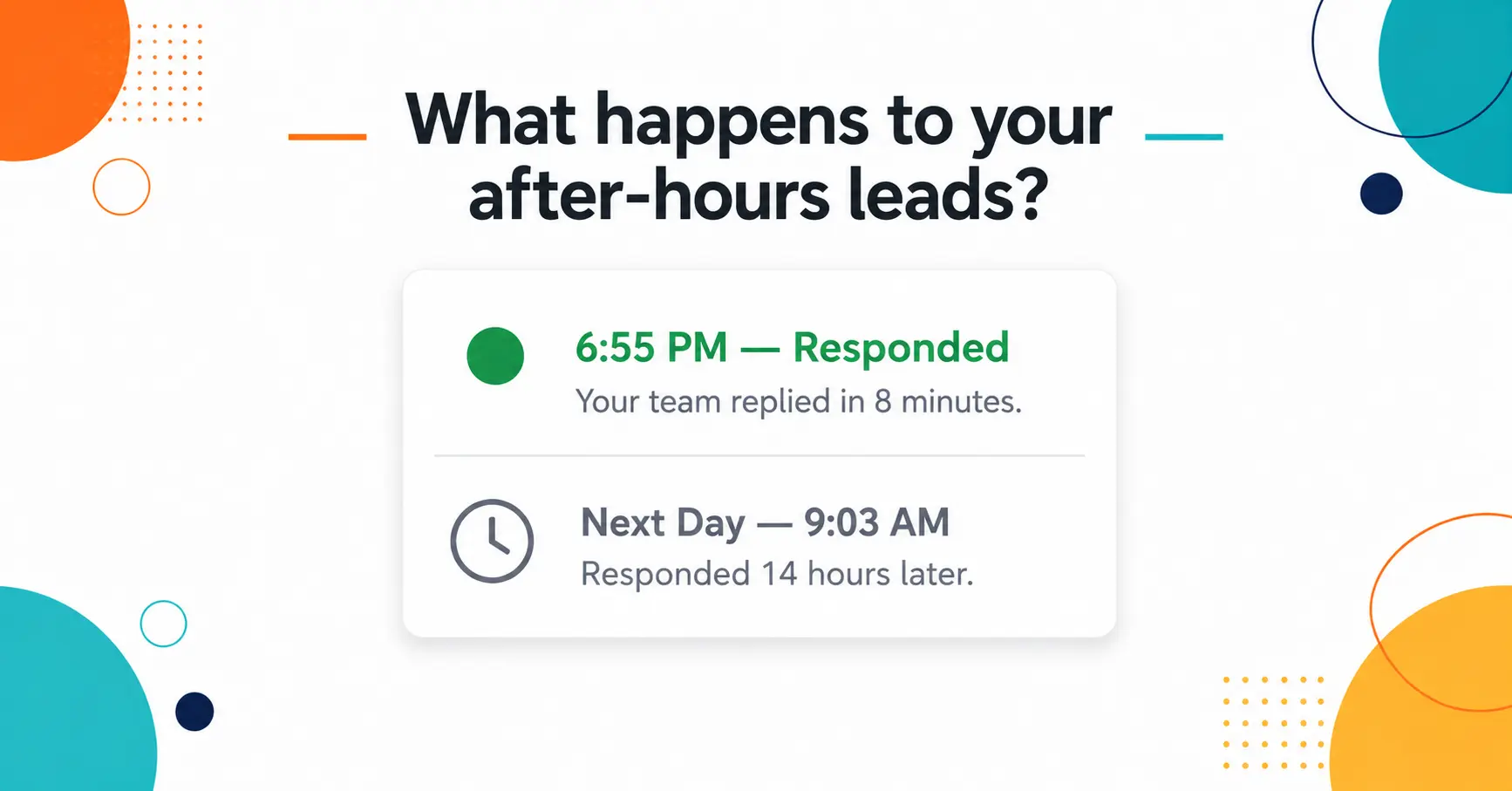
One of those contractors texted her back at 6:55pm.
Not a long message. Not a form letter. Just: “Hey, got your inquiry about the bathroom project. This is Jake, just wanted to reach out. What’s a good time for a quick call?”
She booked a call for Friday at 8am.
The other two saw her inquiry the next morning. One followed up around 9, one closer to 11. Both got the same response: already moving forward with someone else, thanks so much.
Neither of them ever figured out why they lost it.
We hear this story constantly. Not a version of it. This story, with different names and different job types, over and over. And the reason it keeps happening is the same every time: most service businesses haven’t built a system for what happens when an after-hours lead comes in.
The 80% Drop in Contact Rate After the First Hour
Here’s the number that should make you uncomfortable.
Contact rates drop by more than 80% after the first hour. That’s not a number we made up. It’s from years of sales research across industries. After five hours, you’re connecting with fewer than 1 in 10 of the people who originally reached out. Wait until the next morning and you’re mostly just doing courtesy callbacks to people who’ve already decided.
And yet almost every service business we talk to has a follow-up process that goes something like this: form comes in, notification lands in an inbox, someone sees it when they have a moment, they respond when they can. After 5pm, it waits. Friday afternoon? Honestly, good luck.
Nobody designed it this way on purpose. It’s what happens when there’s no system.
Why Most Service Businesses Don’t Have a System for After-Hours Leads
I want to acknowledge the obvious response here, because I’ve heard it plenty: isn’t the answer just having someone monitor leads at all hours? Maybe a part-time VA, or rotating responsibility among the team?
That’s one answer. It’s expensive, hard to keep consistent, and it burns out whoever’s on duty.
The better answer is automation that handles the first response immediately, every time, so that by the time a human gets involved the lead is already engaged and in the system.
What Automated Lead Follow-Up Looks Like in Practice
Here’s what that looks like in practice.
Homeowner submits a form at 6:47pm. Within 60 seconds, she gets a text from the business number. Something short and direct: “Hey, got your request about the bathroom remodel. What’s a good time for a quick call this week?” That’s it. Not a brochure. Not a paragraph about the company’s fifteen years of experience. Just acknowledgment that she exists and someone noticed.
On the business side: that form submission has automatically created a contact in the CRM with the source, timestamp, and her information. A task has been assigned to the right person on the team. If nobody responds to her within a set window, a reminder fires.
From her perspective, these guys are on it. She heard back in under a minute. The other two contractors, who are probably equally skilled and maybe even better priced, felt slow by comparison. That’s the whole game.
The Real Cost: Why Slow Lead Response Is Invisible
The part that’s hardest to see from inside a service business is that this kind of loss is invisible.
When a lead goes cold because of response time, nobody marks it as “lost to faster competitor.” It just disappears. Gets logged as unresponsive, or doesn’t get logged at all. The business has no way to tell whether they lost that job because of pricing, because they weren’t a fit, or because someone else responded eight minutes after the form was submitted.
So there’s no urgency to fix it. The data doesn’t show a problem. The problem just quietly costs you money every week.
How to Estimate What After-Hours Lead Loss Is Costing You
Until you actually try to estimate it. Here’s a rough version: if your business gets 10 qualified leads a week and you’re losing 30% of them to response time, that’s 3 leads a week. Run that number across a year. At even a modest average job value, say $2,000, you’re looking at somewhere around $300,000 in annual revenue that walked out the door because nobody texted back fast enough.
Most business owners we sit with have never done this math. And we understand why. You’re running a business, you’re stretched, this doesn’t feel like the emergency because you can’t see it. But once you see it, it’s hard to unsee.
What the Fix Actually Requires
What the fix actually requires is not complicated.
One place for all inbound leads to land, no matter where they came from. An automated response that goes out within minutes of a new lead coming in. A CRM that captures everything and creates a follow-up task automatically. A simple morning review so the team knows what came in overnight and what needs a human touch.
Most service businesses already have most of the tools to build this. The gap is the connective layer between them. Getting those pieces talking to each other is what we spend most of our time on.
Jake, the contractor who texted back in eight minutes? He didn’t have a big operation. Four guys on the crew, him handling sales, his wife doing the books. He built his lead response system about six months before we talked to him. Cost him a couple weeks of setup time. Now it runs automatically every time a form comes in, day or night, whether he’s on a job or at his kid’s baseball game.
He told me he’d had three situations in the past year where he got jobs specifically because he was the first to respond. He knows this because the clients told him. “You were the only one who got back to us that night.”
That’s the difference between having a system and not having one.
If you’re running a service business and you’re genuinely not sure what happens to a lead that comes in at 7pm on a Tuesday, that’s the thing to find out first.
Our free 30-minute systems audit walks through exactly that: where are your leads coming from, what happens in the first 30 minutes after they arrive, and where are the gaps. No obligation after. Just a clear picture.
Book a time. We’ll tell you what we find.