
Your Small Business Doesn’t Have a Software Problem. It Has a Workflow Problem.
Most small business workflow problems aren’t caused by picking the wrong software. They’re caused by never designing the workflow in the first place.
Marcus runs an HVAC company out of Belgrade. I’m not using his real name, but everything else I’m about to tell you is accurate.
He’d tried four CRMs in two years. Four. I asked him to name them and he could, without hesitating. He’d spent real money and real time on each one. And every single time, leads were still slipping, his team was still doing things by hand, and he was still getting called at night about jobs that should’ve been handled that afternoon.
So I asked him to walk me through what actually happens when a lead comes in.
Long pause.
“Well, it comes into my email…”
Right. That’s the problem. Not HubSpot. Not the scheduling software. Not the CRM he was paying for when we talked. The email sitting in an inbox that someone gets to when they get to it.
I’ve had some version of this conversation maybe fifty times by now. Business owners trying tool after tool, spending money, getting frustrated, and ending up back at square one. And here’s the thing: they’re not making bad decisions. They’re solving the wrong problem.
The tool isn’t broken. The system around it is.
Why Buying Another Tool Doesn’t Fix It
I get why people go straight to the software. When leads are slipping and you’re already stretched thin, you don’t have time to sit down and redesign your whole workflow. You find the thing that’s supposed to handle the problem. You pay for it. You hope it works. When it doesn’t, you feel like you picked the wrong one, so you try a different one.
Marcus wasn’t picking wrong. He was just patching individual spots in a plumbing system that was never designed right in the first place.
Small Business Workflow Problems: The Four Gaps That Show Up Most Often
What I actually found when we went through his operation: leads were coming in from three different places. Website form. Google Business Profile. Facebook. None of those were routing into the same place automatically. His admin, who’d been with him for years and was genuinely great at her job, was copying information from emails into the CRM every single morning. By hand.
If a lead came in at 4pm on a Friday, it sat until Monday.
The CRM he was using was fine. Actually more than fine. But it was receiving data two days late and nobody had touched the automation features that came standard with the plan he was already paying for. He was using maybe 15% of what the tool could do, because nobody had time to set it up properly, because everyone was busy doing the manual work that the tool was supposed to replace.
That loop is the thing that drives me a little crazy, honestly.
Okay. Let me be specific about what breaks down, because I see the same gaps over and over.
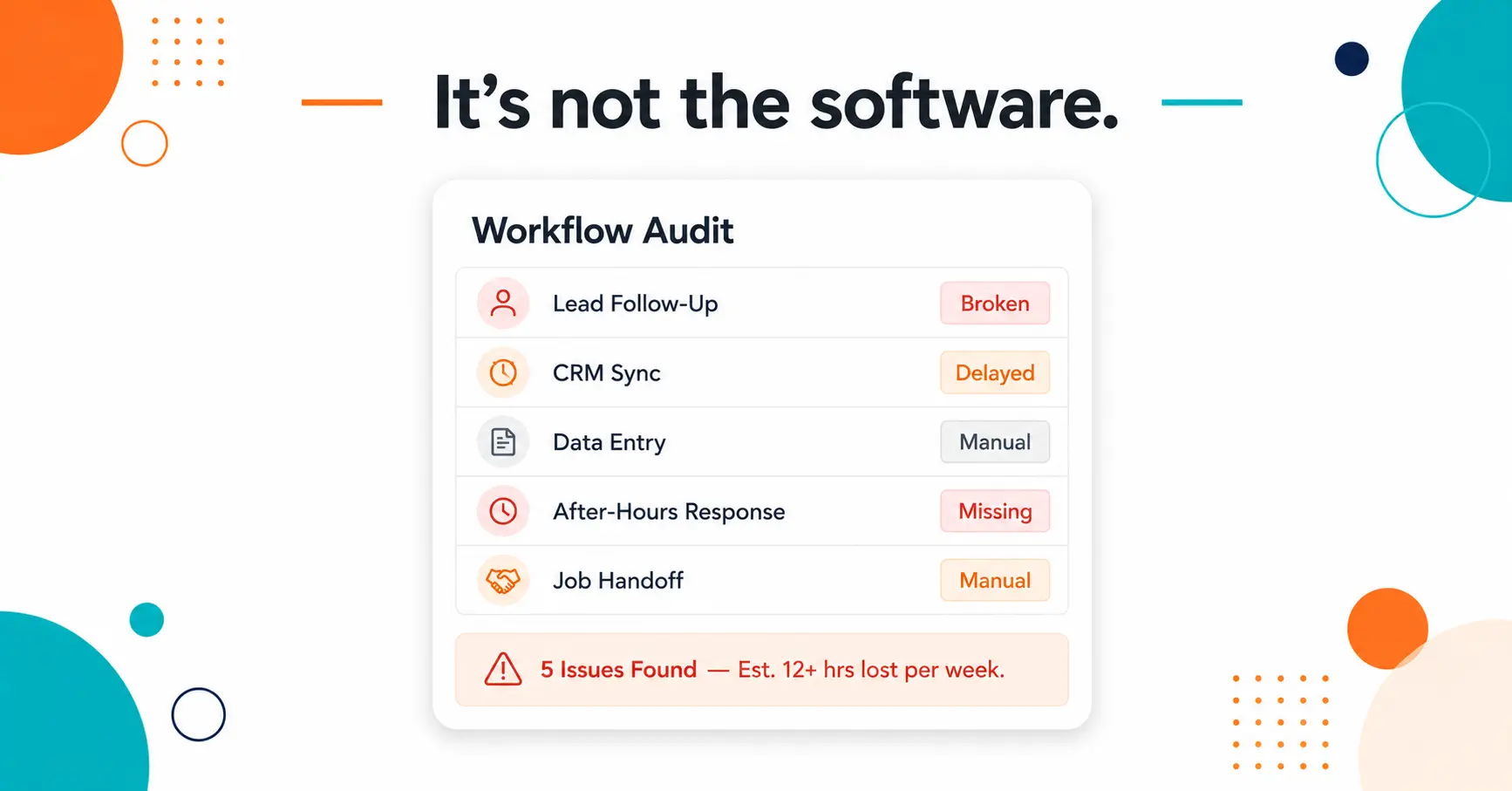
Leads come in from multiple channels and get treated completely differently depending on where they came from. A website lead might get a response the same day. A Facebook message gets seen whenever someone opens Facebook, which is not a reliable process. A referral from a job site gets scribbled on a piece of paper and either makes it into the system or doesn’t.
Data entry is manual somewhere in the chain. Almost always. There is nearly always a person copying something from somewhere into somewhere else. That person is doing other things at the same time. The data they enter is sometimes wrong, sometimes incomplete, almost always delayed.
When a job gets booked, the handoff to the crew is manual. Someone has to update the record, notify the right people, send the confirmation, schedule the follow-up. If that person is swamped that day, parts of it don’t happen.
Reporting requires digging. Want to know how many leads came in last month and what happened to each one? Someone’s spending 45 minutes hunting for that answer. Probably more. And the number they produce is a little off because the data entry has been inconsistent all month.
None of that is a CRM problem. It’s a workflow problem.
What About AI?
One more thing before I get to what the fix looks like, because I know this question is coming: what about AI? Is that the answer?
Sometimes I hate answering this because the honest answer is: kind of, no, it depends.
AI is a component. It is not a system. If your workflow is broken, adding AI to it gives you a faster, more expensive broken workflow. I’ve watched this happen. A business adds an AI chatbot for inbound inquiries but nobody built out what happens after the chatbot responds. Lead comes in, gets an instant reply, responds to that reply, and then disappears because nothing on the back end is set up to route them anywhere or notify anyone. The AI worked exactly as designed. The system didn’t exist.
For the right tasks, AI saves real time. Drafting first responses. Qualifying leads before a human gets on the phone. Summarizing intake notes. Those are real use cases. But the AI has to sit inside a workflow that someone actually designed.
What the Fix Actually Looks Like
For Marcus, the fix took about two weeks and zero new software. We connected his three inbound channels so everything landed in one place automatically. We built an automation that texted every new lead within ten minutes of coming in. We set up a weekly summary that showed him where every open lead stood in the pipeline.
His team didn’t change. His tools didn’t change. His workflow did.
He called me about three weeks later and said it was the best month he’d had in two years. I want to be careful not to oversell that because there were other things going on in his business and I don’t know exactly what to credit. But the leads weren’t disappearing anymore. That part was clear and it was immediate.
If you’ve tried a few tools and nothing quite worked, the problem is almost certainly the system around the tools, not the tools themselves.
That’s what we dig into during the free 30-minute systems audit. We map what’s actually happening in your operation, find where the gaps are, and give you a clear answer on what the fix is. No pitch afterward. No pressure to hire us. Book a time and we’ll figure out where your system is breaking down.
Thayer is the founder of Waypoint Systems AI, an operational consulting firm based in Bozeman, Montana. He has worked with 30-plus service businesses on their operational systems. You can book a free systems audit here or read more about what happens to leads after hours.