
The 60 Leads Nobody Owned
There is a specific kind of awkward that happens when two people from the same business reach out to the same prospect on the same day.
The owner sends a follow-up email in the morning. The community manager calls in the afternoon. The prospect picks up, mentions they already heard from someone, and now you are in a conversation that starts with explaining why your team does not talk to each other.
That was happening at Oz Bozeman, a coworking space here in town. Not constantly. But often enough that it had come up. Both the owner and the community manager were pulling from the same lead list with no clear system for who owned what. Coworking space lead management, in their case, meant a shared spreadsheet and a lot of good intentions.
Why Leads Get Lost at Growing Coworking Spaces
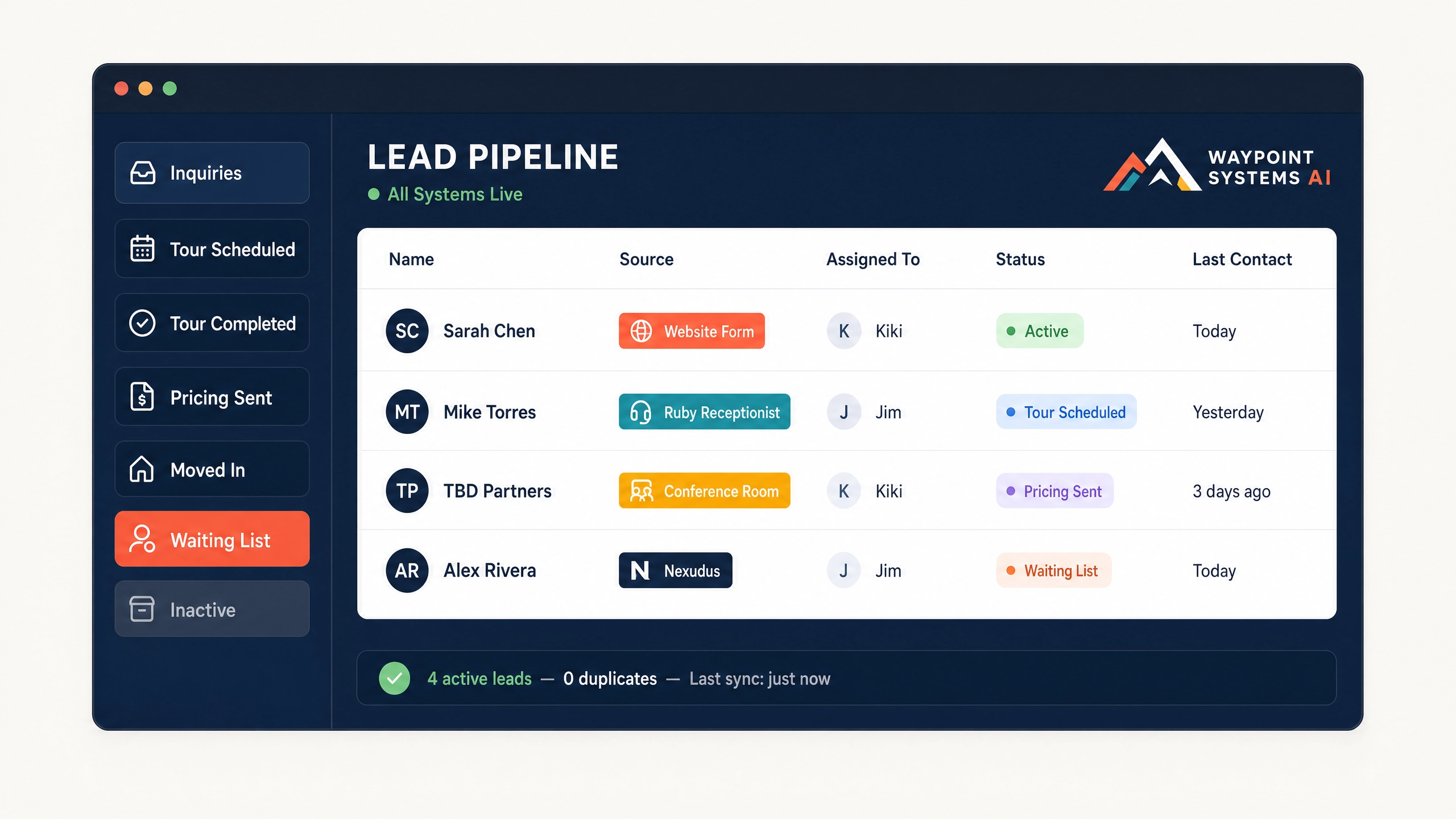
Oz Bozeman was getting inquiries through three separate channels: website forms, their Ruby Receptionist phone service, and direct conference room booking requests. Each channel worked. The problem was that none of them connected to anything. A form submission landed in one place. A phone inquiry got logged somewhere else. A booking request came in through a third inbox.
When leads come in through multiple channels with no central routing, a few things happen reliably. First, the same person can show up in two places and nobody knows. Second, leads without assigned owners get looked at when someone has time, which means some of them never get looked at. Third, the team starts to lose confidence in whatever list or system exists because it’s always slightly wrong.
When I pulled up their pipeline, there were more than sixty names sitting in a spreadsheet with no owner, no follow-up date, and no status. Not sixty bad leads. Sixty leads that had arrived, been seen by someone, and then drifted into a holding pattern that had no natural exit.
Nobody had ignored those people on purpose. The system just had no mechanism to force a decision about each one.
What Good Coworking Space Lead Management Actually Requires
The specific challenge here was routing. Not conversion rate optimization, not lead generation, not CRM selection. Routing: getting every lead from wherever it arrived into one place, assigned to one person, with a clear next action.
For Oz, that meant connecting three sources to their existing CRM, Nexudus, in a way that:
- Pulled every form submission, phone inquiry, and booking request into one pipeline
- Checked for duplicates automatically before creating a new record
- Assigned ownership through a round-robin rotation between the owner and community manager
- Sent an SMS to the assigned person within seconds of the lead arriving
- Moved leads to a waitlist automatically when occupancy approached capacity
- Archived leads that had gone inactive after fourteen days with no touchpoint
The deduplication was the piece that made the biggest immediate difference. In the first week, sixty-plus stale records got auto-archived. That number being as high as it was made sense once we looked at the history: leads had been accumulating in the spreadsheet for months with no cleanup process. There was no moment where someone sat down and said, “this person is not coming in, let’s clear them out.” So they just sat there, making the list longer and less trustworthy.
The SMS Notification Changed the Everything
Before the system went in, a lead would arrive and someone might see it that day. Or they might not, depending on how the day was going. The follow-up happened when there was a moment to sit down and check the list.
After: the assigned person gets a text within seconds. That is a different operating posture. There is a real difference between “I’ll check leads when I have time” and “someone just sent me a notification about a new inquiry.” The first one gets scheduled for later. The second one gets handled.
I want to be accurate about what that difference means for a coworking space specifically. Response speed matters more for some businesses than others. A law firm or a contractor is often competing on who calls back first, because the prospect is making an urgent decision. A coworking space prospect is usually in an exploratory phase. They are looking at a few options, not making a same-day decision.
What matters more for Oz is that follow-up is consistent and non-embarrassing. Reaching out twice because the team did not know who owned the lead is worse than being a bit slow. The SMS notification solved that problem by making every lead owned the moment it arrived.
The Monday Digest Nobody Asked For but Everyone Used
One thing that came out of the build that was not in the original plan: a Monday morning SMS digest.
Every Monday, the owner gets a two-paragraph summary via text: how many new leads came in the previous week, current waitlist status, and which leads are approaching the fourteen-day archive threshold and might need a final outreach before they drop off.
This came from a conversation about how the owner actually operates. He is on the floor most of the day. He is not sitting in front of a dashboard checking metrics. A weekly summary he can read in ninety seconds while walking across the space turned out to be more useful than a real-time dashboard he would rarely open.
That kind of decision, choosing the delivery format that fits how someone actually works rather than how the system works best, is something I think about on most projects. A system the team actually uses beats a system with better features that nobody checks.
What Sixty Stale Leads Actually Cost
I am careful about making revenue projections from work like this. Not every one of those sixty leads would have converted. Some were window shoppers. Some had already made a decision elsewhere. The conversion math is always messier than it looks.
But here is the thing worth thinking about. A coworking space in a market like Bozeman is spending real money and real time to generate leads: SEO, word of mouth, community presence, events. Every dollar and hour that goes into generating an inquiry has a cost. When those inquiries sit in a spreadsheet for weeks without a follow-up, the cost of generating them becomes waste.
Fixing the lead management system did not create new leads for Oz. It recovered the value of the leads already coming in. That is a different kind of ROI, but it is a real one.
When the System Is the Problem, Not the CRM
The most common version of what I saw at Oz is a business with a CRM they bought and are not fully using, sitting alongside a process that still runs on spreadsheets and memory. The CRM is not broken. The routing layer between the inbound channels and the CRM just does not exist.
Buying a better CRM would not have fixed Oz’s problem. Nexudus was fine. The gap was the connection layer: something that took every lead from every source, deduped it, and put it into the system with an owner and a timestamp.
That layer is almost always buildable with what a business already has. The work is in knowing what to connect and in what order.
If you are running a service business and you are not confident about what happens to a lead in the first thirty minutes after it arrives, that is the question to answer first. The free 30-minute systems audit is how we start. We map what is actually coming in, where it goes, and where it stops. No pitch after that.
Thayer is the founder of Waypoint Systems AI, an operational consulting firm based in Bozeman, Montana. He has worked with 60-plus service businesses on their operational systems. Book a free systems audit here.